

“Centuries Are Against Them”
On constitutionalized jingoism

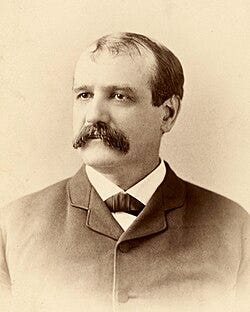
In 1896, Francis Amas Walker was already one of the United States’ leading statisticians and political economists. The scion of a powerful Boston family, Walker was by then the President of MIT. His pioneering work on the US census earned him far-flung acclaim.
But in 1896, Walker published a controversial essay in The Atlantic. In a social-scientific register, he made the case for ending America’s longstanding traditions of relatively open immigration. Walker’s core claim was that more recent immigrants were fundamentally different than the waves of immigration earlier in the nineteenth century. The new immigrants, he argued, were peoples whom history had allegedly left unprepared for American economic and political life.
Walker argued that the new immigrants from Italy, Austria-Hungary, Russian, and southeastern Europe were “beaten men from beaten races.” Dealing categorically, he wrote that older immigrant groups came with centuries of cultivated habits favorable to self-government. These newer immigrant, Walker argued, were formed by centuries of subordination. Quote:
Centuries are against them, as centuries were on the side of those who formerly came to us.
Walker’s arguments were recalled in my mind by a recent controversy. In the unending saga that is Ilan Wurman, we have a new episode. Some scholars have criticized Wurman in recent days because of an internet clip in which he explains his policy concerns around Birthright citizenship. Responding to his critics, Wurman posted an outline of his views which I will happily admit accurately reflects the content of the internet clip. But whereas Wurman sees his outline as vindicatory, I see something like Walker’s old writings. See the screenshot below.
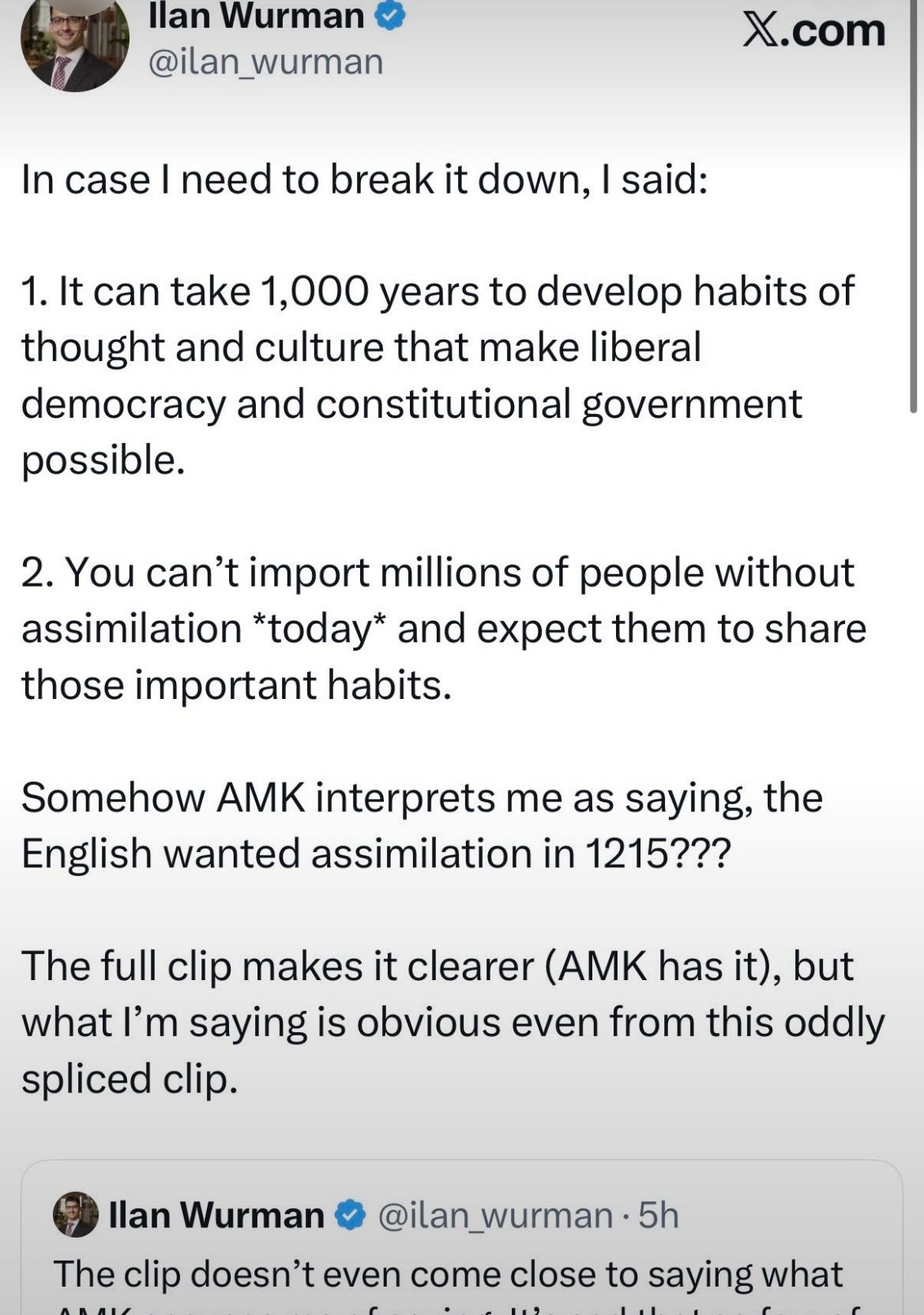
To do some throat-clearing, this is in my opinion a loathsome and implicitly bigoted set of assumptions. Wurman’s points also ignore American history, which has time and again shown that the kinds of people Francis Walker feared have assimilated into mainstream American culture. We might also ask who has a better grip on the notes and themes of the Anglo-American constitutional project. Is it the Venezuelan migrant who suffers unthinkable dangers to find democracy and the rule of law, to find refuge from arbitrary personal rule and corruption?
Beyond the loathsomeness of it all, there is some nuance that is worth unpacking. I saw a law professor online compare Wurman’s comments to blood-and-soil nationalism. While I certainly understand the comparison, I don’t think it’s precisely correct. Wurman’s comments, as well as Francis Walker’s writings, reflect recurring instincts that I would alternatively call either civilizational nationalism or constitutionalized jingoism. I like the term “constitutionalized jingoism” because this mode of argument often turns on the Anglo-American constitutional project.
Some may ask, well what’s the point of drawing distinctions once you’re down in the gutter? I want to reveal the differences to point out the dishonesty of constitutionalized jingoism. Blood-and-soil nationalists, despite being vile, don’t really hide the ball. There’s something cruel at the heart of constitutionalized jingoism that I want to explore.
A Constitution Produced by a People
Constitutionalized jingoism begins from an insight that is not necessarily wrong. Constitutional government depends on more than constitutional text. Liberal democracy requires habits, practices, and forms of restraint that cannot be reduced to a written document. People must tolerate disagreement, accept electoral defeat, distinguish political opposition from treason, and recognize that winning an election does not confer ownership of the state. Institutions and practices depend on dispositions.
Then comes the bigoted move that sets things in motion. Those dispositions on which well-running democracy depend are assigned to a particular civilization. Constitutional democracy becomes the product not of institutions operating in the present, but of a people developing across centuries. The law is the surface. Beneath it lies culture. Beneath culture lies history. And only some people have lived the right history.
The result is a division between populations that possess constitutional habits and populations that do not. Some people arrive carrying an accumulated inheritance of liberty. Others arrive carrying the consequences of autocracy, hierarchy, religious difference, poverty, or political disorder. They may learn the constitutional rules or mouth the creed. But they do not necessarily possess the deeper habits that make the rules of good government work.
This is where Walker becomes useful in illustration.
Walker didn’t just complain that the newest immigrants were poor or unfamiliar with American institutions. He argued that they lacked the historically produced “ideas and aptitudes” necessary for self-government. Their defect existed before they boarded the ship. It arose from the political histories of the societies from which they came. The problem was civilizational development.
The earlier immigrants, in Walker’s account, had been formed by centuries that prepared them for America. The newer immigrants had been formed by centuries that prepared them for something else. This wasn’t the sort of thing education could fix (at least not on a timescale that mattered).
Walker’s essay became part of an organized campaign for immigration restriction at the end of the nineteenth century, when elite restrictionists warned that “undesirable immigrants” threatened the American way of life. The rhetoric was more respectable than a crude declaration of racial hatred. It spoke the language of political capacity, social science, civilization, and constitutional preservation.
But its practical conclusion was easy enough to understand: the people arriving now were not like the people who had arrived before.
Centuries were against them.
The Ancient Culture and the Instant Test
The contemporary argument reproduces Walker’s structure.
The habits required for liberal constitutionalism took one thousand years to develop.
Immigrants must assimilate “today.”
Put those propositions together and the contradiction is immediate. If the relevant habits genuinely require a millennium to develop, then no living immigrant can acquire them. Neither can the immigrant’s children. Neither, presumably, can the grandchildren. So on and so on for a long while. The historical premise swallows the assimilation proviso.
The immigrant is told that membership is available, but only after acquiring a culture produced over centuries.
But the immigrant only has until today.
Assimilation functions here as an escape hatch for the person making the argument, not for the person subjected to it. It permits the speaker to deny that the argument is racial or exclusionary. The door is theoretically open. Anyone can become an American.
But the conditions placed upon entry cannot be satisfied. The essential qualification isn’t allegiance, knowledge, conduct, or participation. It is possession of historically sedimented habits that supposedly required a thousand years to form.
The argument thus contains two different accounts of culture. When defending itself against the charge of ethnonationalism, it treats culture as learnable: immigrants can assimilate. When explaining why immigration is dangerous, it treats culture as inherited: constitutional habits take centuries to develop.
Culture is flexible when exclusion must be denied and immovable when exclusion must be justified. This, from my perspective, is not something available through blood-and-soil nationalism.
This bind is how constitutional jingoism can perform the work of racial nationalism without making an explicit claim about blood. It formally permits conversion while defining the faith as an ancestral memory.
The Moving Line
Walker’s particular targets make the argument’s historical instability obvious. He was writing about Italians, Hungarians, Austrians, Russians, and other southern and eastern Europeans. These were the people history had allegedly failed to prepare for American self-government. Today their descendants are routinely absorbed American culture. The notion of their ancestors’ supposed defects has vanished from memory.
This is a recurring feature of American nativism. The population that arrived earlier becomes evidence of successful assimilation. The population arriving now becomes evidence that assimilation has reached its natural limit. That move is an incredible magic trick that distorts our memory of the past.
The old immigrant is industrious, family oriented, patriotic, and culturally compatible. The new immigrant is dependent, clannish, lawless, and politically alien. The old immigrant wanted to become American. The new immigrant wants to transform America. The old immigrant arrived through the proper channels, often channels that did not yet exist in their present form. The new immigrant is part of an invasion. (Or as one Senator from the 1870s put it, a “Mongol horde.”)
The boundary moves because the argument is not really about identifying an objective quantum of assimilation. It is about preserving the authority of established members to decide that the newest arrivals have not earned membership.
Walker could praise the political inheritance of earlier immigrants because they had already become part of the nation’s retrospective self-image. The Irish and Germans, once treated as threats to republican government, could now be enlisted against Italians, Jews, Slavs, and others. The excluded population changed. The constitutional story remained the same.
Centuries always seem to favor the people who are already here. We forget so much.
The Noncitizen’s Triple Bind
This framework places the noncitizen in a no-win situation.
The noncitizen is first told that political membership must be earned through assimilation. But political membership is itself one of the principal means through which the habits associated with citizenship are formed. Participation produces attachment. Security encourages long-term investment in communities. Schools, workplaces, unions, churches, neighborhoods, and public institutions create civic relationships. Political rights teach people how political institutions work because they permit people to use them.
Constitutional jingoism reverses the sequence. It demands the product of inclusion as a prerequisite for inclusion.
The noncitizen must demonstrate the habits of citizenship before being permitted to become a citizen.
The test is impossible because noncitizens are denied many of the activities by which democratic capacities are conventionally measured. They cannot vote in federal elections. They do not possess an equal claim on public institutions. Their continued presence may depend on administrators, employers, family relationships, or legal categories they cannot control. They may be subject to removal from the community whose culture they are commanded to adopt.
And then their political marginality can be offered as evidence that they have failed to assimilate.
They do not participate enough. But participation is restricted.
They do not form durable attachments. But their right to remain is insecure.
They preserve relationships with their places of origin. But the state has refused to assure them that this place is home.
In the end, the noncitizen must behave as though membership in the American community is secure while knowing that it is not.
That is the first trap.
The second is that individual conduct cannot answer a civilizational accusation. A particular immigrant may learn English, obey the law, study American history, serve in the military, establish a business, raise a family, and participate in civic life. None of this disproves a claim about what happens when “millions” of people are “imported.” The individual disappears into the population.
(This is, I should say, made worse when the advocates of constitutional jingoism keep it even vaguer. Wurman does not specify which “people[s]” might lack the capacities for democratic self rule. If this is his position, he should tell us with some clarity which peoples are so deficient in his mind.)
This is one reason the word import matters. It strips migrants of their individual moral agency. Imports do not make choices, form attachments, change their minds, or contribute to institutions. They arrive as a mass. Once the immigrant has been converted into a unit of demographic material, nothing the individual immigrant does can defeat the aggregate presumption.
Success becomes anecdotal. Failure becomes representative.
The immigrant who thrives is an exception. The immigrant who struggles reveals the truth about the group.
That is the second trap.
The third is temporal. The noncitizen is ordered to assimilate immediately into a culture defined by its ancient development. Any pace is too slow because assimilation is required “today.” But no achievement is deep enough because constitutional culture took a thousand years to mature.
The person must change instantly.
The civilization could change only gradually.
Centuries were available to one and denied to the other.
Blood and Soil, or Something Else?
So was the law prawf right to call this blood-and-soil nationalism?
The description captures something important. The argument distinguishes between a historically formed people and masses arriving from outside it. Blood-and-soil nationalism is often about an authentic bond shared in the DNA or shared existence of a coherent people who are connected to a specific land. Constitutionalized jingoism is different. It describes migrants as imported material. It connects national survival to the preservation of inherited cultural characteristics. And its account of assimilation is so temporally impossible that culture begins to operate much like descent.
But there is still value in distinguishing the argument from blood-and-soil nationalism in its strict form. The distinction helps us understand the particular American tradition at work and see its cruelty.
The argument is closer to Walker than to a Nazi slogan of Blut und Boden. It does not begin with the mystical union of race and territory. It begins with self-government. It claims that liberty rests on inherited habits and that immigration threatens to separate constitutional forms from the civilizational substance that sustains them.
That framing has often allowed American nativism to present itself as the defense of liberalism rather than its negation. The restrictionist does not hate outsiders, he says. He is worried about constitutional government. He does not believe in racial hierarchy. He believes in political culture. He does not reject immigration. He demands assimilation.
Walker supplied an especially clear version of the maneuver. His alarm was expressed as concern for democratic capacity. He historicized his concerns. Some peoples had accumulated the necessary aptitudes. Others hadn’t. Their exclusion could therefore be characterized not as prejudice but as prudence.
The emphasis on “civilization” makes the argument sound more refined.
My choice of the word “nativism” reminds us what this mode of argument does in the world.
Constitutional Habits Are Things We Do
There is a better way to take seriously the cultural foundations of constitutional government.
Constitutional habits are not relics deposited in a people’s character over a thousand years. They are practices continually produced or destroyed by institutions that are interacting endogenously and in contingent ways with many kinds of peoples. Those peoples then work their own force on the trajectory of the Anglo-American constitutional project. The project shapes the people as the people shape the project. It is an endogenous interaction all the way down.
A government teaches constitutional restraint when its officials accept legal limits. Juristocrats teach equality when they extend equal protection to people whom majorities regard as outsiders. Political parties teach democratic loyalty when they accept defeat. Legislatures teach pluralism when they bargain across disagreement. Citizenship teaches membership when the state treats citizenship as membership rather than as a rebuttable presumption.
These habits can be learned. They can also be forgotten, distorted, or perverted.
A recent immigrant who believes in political equality may possess them. A tenth-generation citizen who believes the state belongs to his cultural group may not. A noncitizen may display extraordinary faith in American institutions. A president may spend years teaching millions of citizens that those institutions are fraudulent whenever they refuse his commands.
Constitutional jingoism directs our attention outward. It asks whether newcomers have acquired the habits necessary to preserve constitutional democracy. That question conveniently distracts from the citizens and officials currently dismantling those habits from within.
Walker was wrong about the people he described. The descendants of his “beaten races” did not destroy American self-government. They became workers, neighbors, soldiers, public officials, organizers, voters, and citizens. They changed the country, as every generation changes it. In doing so, they became part of the historical tradition that later restrictionists would (unironically) claim for themselves.
The lesson is not that assimilation never matters. It is that assimilation cannot be made into a test whose content is ancestral and whose deadline is immediate. A constitutional democracy cannot require outsiders to possess the fruits of membership before allowing them to belong. Nor can it define its political virtues as the inherited property of the people who arrived first.
“Centuries are against them” is an elegant sentence. That is part of what makes it dangerous. It transforms a political choice into the judgment of history. It tells us that exclusion is not something we are doing. It is something time has already decided.
But centuries do not vote, naturalize, exclude, deport, or confer citizenship.
People do.
Epilogue
Well, Wurman did not take this post very well. See below.
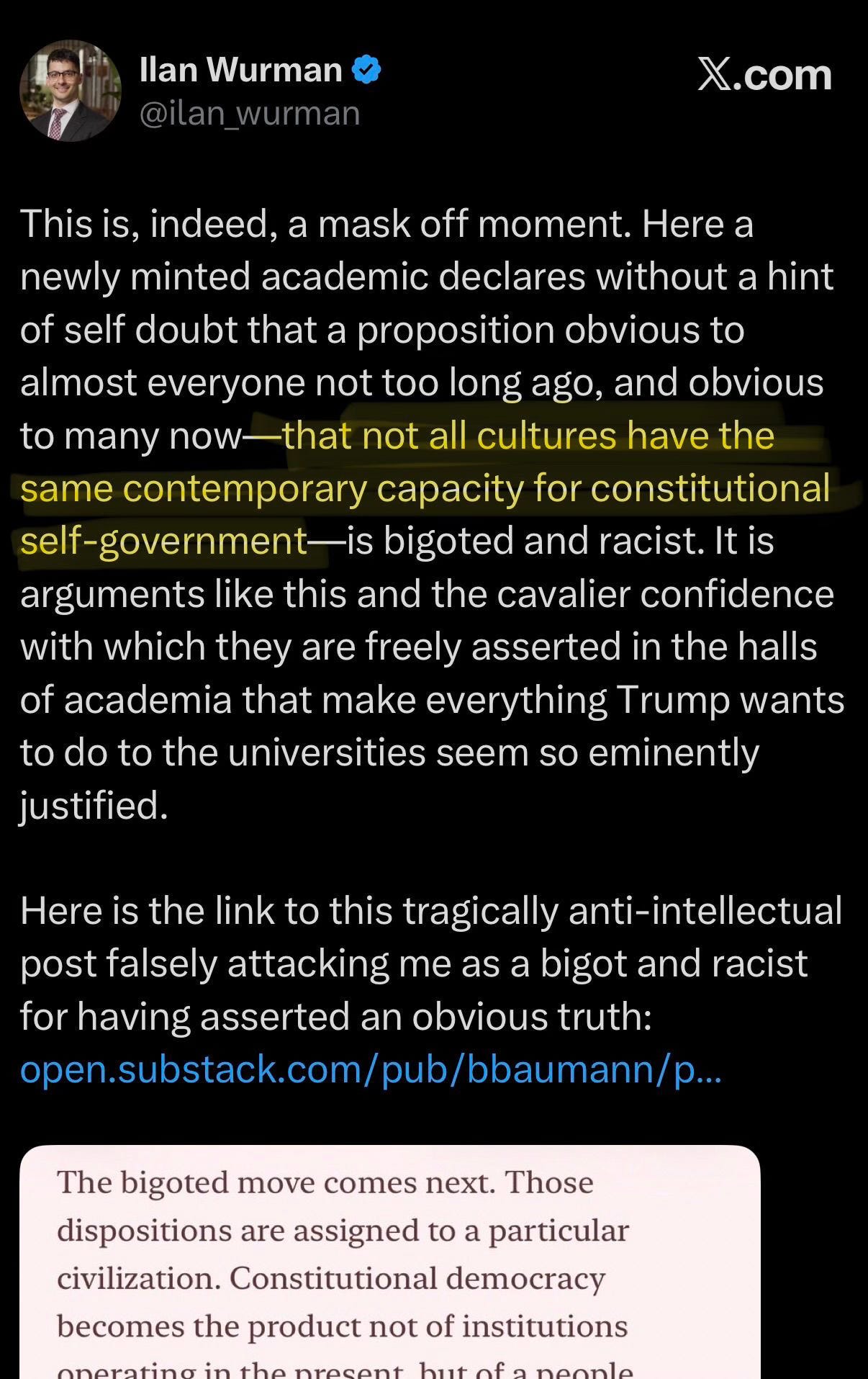
The most remarkable thing about this response is that he doesn’t seem to claim that I’ve gotten his views wrong. The “proposition” I discuss in this Essay is, it seems, absolutely his. The only thing he disputes is whether that proposition is in fact bigoted. And on that, I pretty much have to leave it to the capacities of my fellow man. I think that if you are capable of a historicized perspective on American history, you will understand that Wurman’s words are descended straight from the mouths of people who lived in the gutter. Constitutionalized jingoism was tired long before Wurman was ever born. I rest my case.
But Jesus, look at this response.
For starters, Wurman jabs at me by calling me a “newly minted” law professor. I don’t know about you, but if someone ever comes with receipts to explain how my words fit a historically recurrent mode of bigoted thinking, I hope I have a better defense than, the balls on this kid!
Second, Wurman appeals to history. Many people in the past, we are told, shared his beliefs. Who cares? We used to burn witches. We’ve come a long way.
But then, set off by m-dashes, Wurman basically confirms my characterizations of his beliefs. He writes, “not all cultures have the same capacity for constitutional self-government.” I would really like him to tell us which cultures he is talking about. But yeah, this is just a bigoted way of casting moral deficiencies on entire swaths of people. It’s also just a really lazy way of talking about the present and the past. As Jamelle Bouie wrote later,
“an obvious truth” this guy is high on his own supply. It is not actually an “obvious truth” that some cultures lack the capacity for self-government. that is a proposition that you need to argue.
I didn’t write this essay to get Wurman in trouble. I was shocked that his words went down so easy on a public-facing platform. I thought that by unpacking them, I could wake people up to a historically recurrent mode of bigoted thinking.
I could have said more. I could have asked, gosh, shouldn’t this person’s recourse to a bigoted mode for making claims on the past throw his credibility into doubt when he writes legal history? Doesn’t this evidence patterns of thought and instincts that are totally inconsistent with sound historical thinking?
But Ilan blew up anyway. And in the process, he appeared to be all too content with the MAGA-led assault on higher education. I would go ahead and say that this is pretty consistent with the essay I wrote about his incompatibility with the knowledge-production game. We are not, it seems, playing the same game.
Finally, I’ll just note that this reply is classic Wurman. This guy has caught a lot of flack in recent years. His responses are predictable. He usually claims to be the victim of a liberal intellectual establishment that’s out to get him. Wurman also talks a lot of smack about the same “ivory tower” in which he has ensconced himself over many years of incremental decision making.
It’s the same move here. But note that it’s like he’s not even putting in any effort anymore. Wurman says that I attacked him for being a “bigot” and a “racist.” Did I ever say either thing? If you read my Essay, the word “racist” is never used in connection with Wurman. I do use the word “bigoted.” But a close reading (or really any reading at all) shows that I never called Wurman himself a bigot.
You see, I do not traffic in rhetorical strategies that deny people agency. I would not use the words “racist” or “bigot” because Wurman can just stop using bigoted words and rhetorical strategies. I do not claim to know what is in his heart or in his mind. All I can do is evaluate his words with the brain that I have, hopelessly addicted to historicized thinking as it may be.
I’m left really tired of engaging with this guy. I hope readers got something out of the analysis of constitutionalized jingoism. That’s really what I was after. History is not something that can solve our issues for us today. But historicized thinking can give us roadmaps for understanding the world around us. The moment we’re living in isn’t entirely new. There are echoes of the past. This Essay is just one example of my attempts at using historicized thinking to help my readers understand the connections between past and present, along with the dizzying politics that are happening all around us.
God willing, this will be the last chapter in the Wurman saga for Passing Political Time.
When I think about people who lack the history and culture to participate in a democracy, I immediately call to mind the descendants of Klansmen.
It bugs me that both parties in this dialog talk about 'assimilation' like it is a good thing. The word might as well be 'erased', for the culture being so treated. It is saying "our traditions are better than yours, so yours must die." It is hard to imagine a less democratic approach. The receiving culture and the arriving culture both need to reach an accommodation for co-existence.
Everyone from every culture is capable of discarding historical traditional elements that prevent a happy accommodation. No culture has gotten to this point in time without having done so a zillion times.